
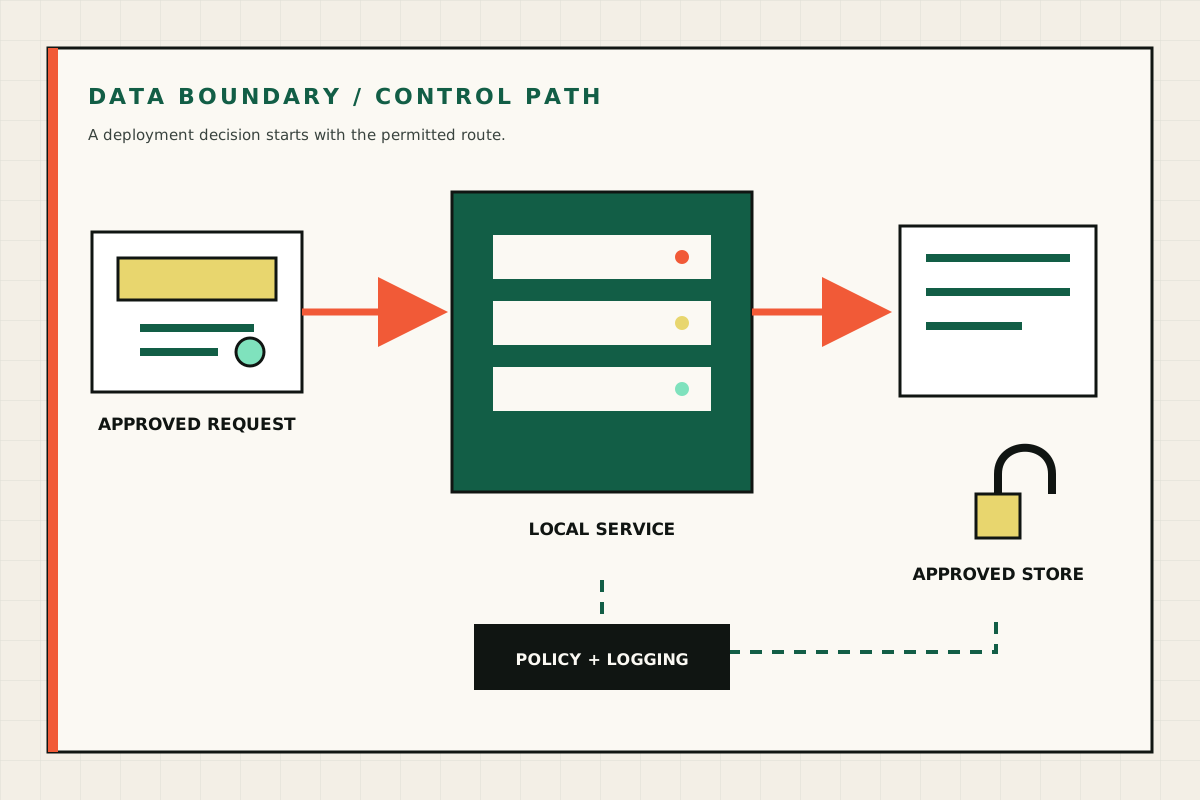
There is no universally fastest or simplest inference runtime. Start with the exact checkpoint, hardware and service contract, then benchmark supported candidates.
Comparison frame
For each runtime, verify:
- the exact model architecture and weight format;
- supported GPU architecture and operating environment;
- quantisation and parallelism routes;
- API and tool-use behaviour required by the application;
- observability, authentication and deployment controls;
- reproducible quality and load results.
An OpenAI-compatible API shape does not make model behaviour or every feature equivalent.
vLLM
vLLM is a general serving route for many supported model architectures and exposes an OpenAI-compatible server. Its scheduler, cache management and distributed options make it a strong baseline candidate for shared language-model inference.
Pin the version and check the exact checkpoint support notes. A model family appearing in documentation does not validate every revision or custom implementation.
SGLang
SGLang combines a serving runtime with structured generation and agent-oriented programming capabilities. Its official benchmarking tools expose request rate, concurrency, first-token latency, inter-token latency and throughput.
Evaluate it where the supported checkpoint and application pattern align. Keep framework-level features separate from measured hardware performance.
TensorRT-LLM
TensorRT-LLM is NVIDIA’s inference stack for supported NVIDIA platforms and models. It offers specialised build and runtime paths with extensive optimisation options.
The operational trade is precision: engine construction, compatibility and configuration need controlled artefacts. NVIDIA’s published performance tables are reference points under disclosed conditions, not a promise for a different GPU RIGS build.
llama.cpp
llama.cpp provides a portable inference route centred on the GGUF ecosystem, with CPU and multiple accelerator backends plus a server application. It is useful for compact deployments, mixed CPU/GPU offload and supported quantised models.
Compare the exact GGUF conversion and backend. Results from a different quant or offload split are not interchangeable.
Operational decision
The chosen runtime must be maintainable after the demonstration. Record container or binary digest, driver, CUDA or backend version, launch configuration, model revision, access controls, health checks and rollback route.
If a runtime only works from an unrecorded command in one shell, the service is not yet supportable.
Benchmark all candidates fairly
Use the same accepted dataset, checkpoint or quality-equivalent artefact, request distribution and hardware. Warm up consistently, disclose caches and record errors.
Compare:
- task quality and feature completeness;
- time to first token and end-to-end percentiles;
- per-request and aggregate throughput;
- memory, power and stability;
- deployment effort and recovery;
- release cadence and upgrade risk.
The best runtime is the one that passes the full service requirement with a controlled operating route. GPU RIGS does not publish a runtime winner until that comparison has been run on the exact reference build.
Technical context
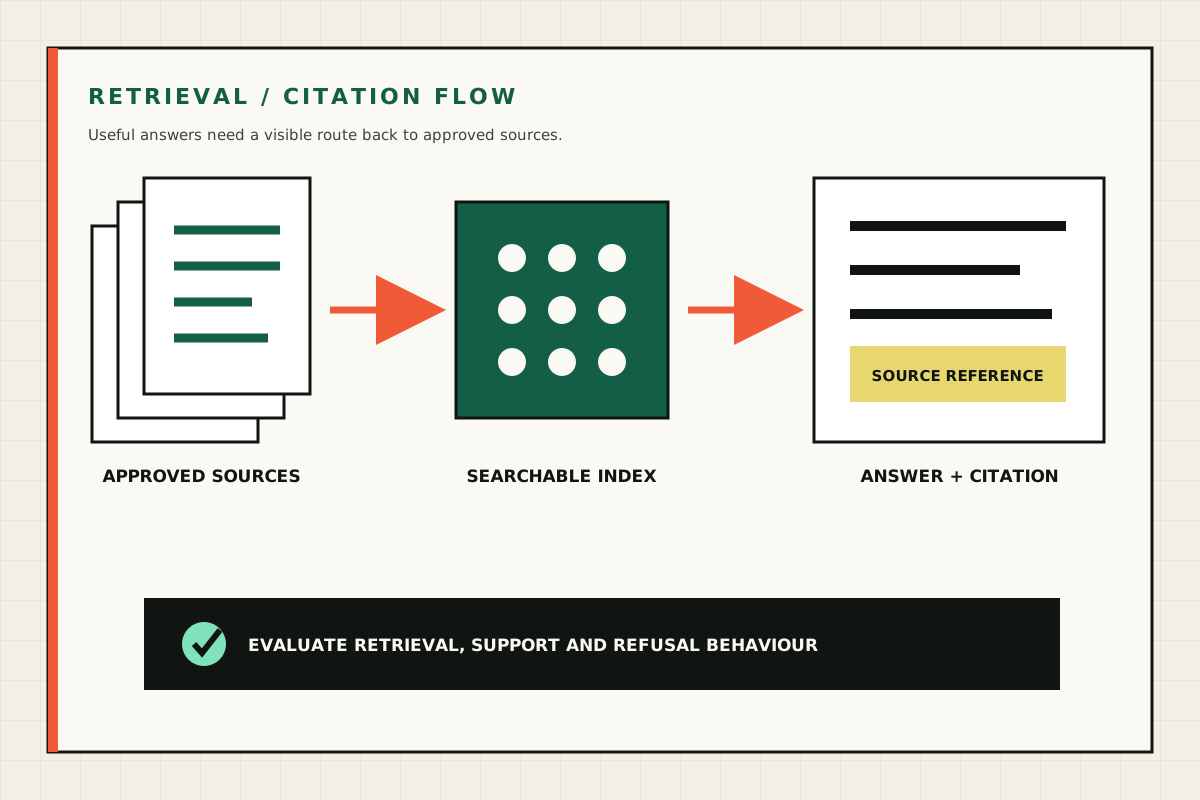
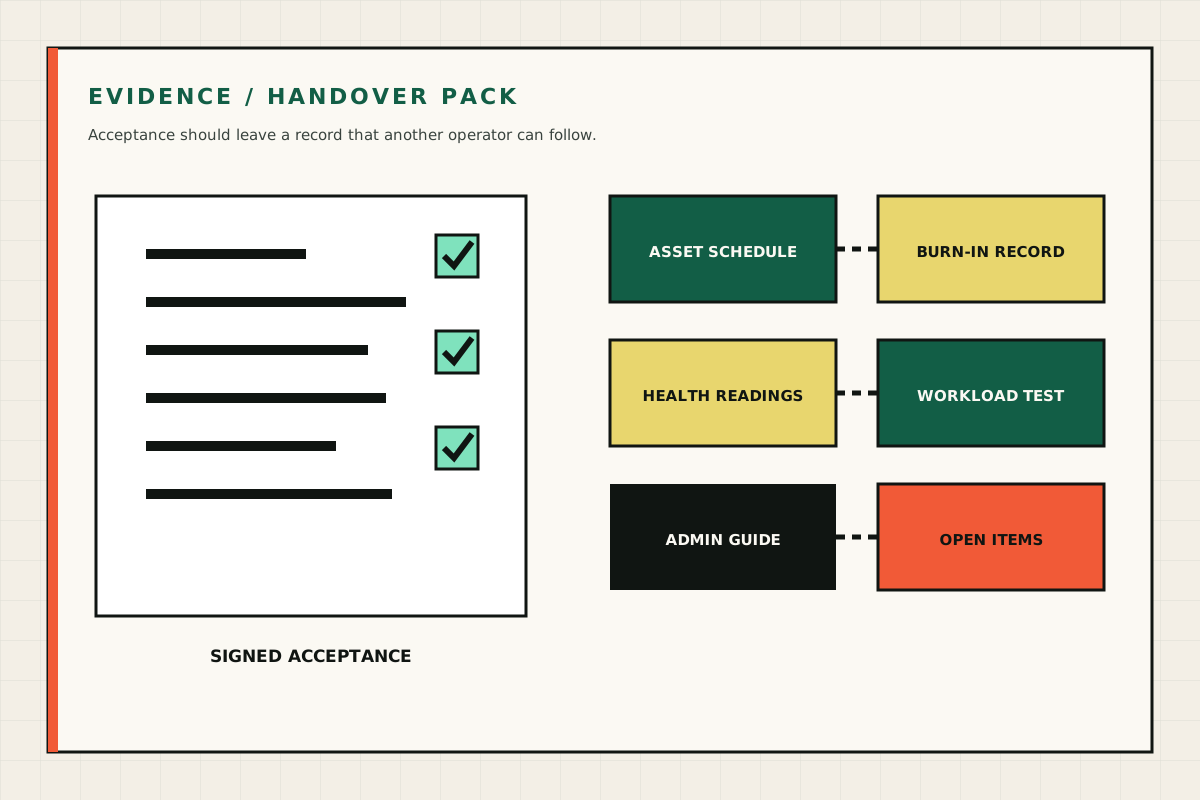
See the physical and operating boundary
Use these views to connect the guide to the machine, its airflow and its operating environment. Captions state the limits of what each image shows.


Primary sources
Sources are checked at the review date. Platform terms, prices and public guidance can change; verify them at the point of decision.